

Unequal Justice After Tragedy
When a family loses someone to homicide, the last thing they should face is a system that questions their right to relief. Yet Daniel Semenza, associate professor in the Department of Sociology, Anthropology, and Criminal Justice at Rutgers University–Camden and Director of Interpersonal Violence Research at the New Jersey Gun Violence Research Center, has found that the very programs designed to help grieving families often deepen existing racial inequities. His new article, “Racial Disparities in Victim Compensation Among Homicide Survivors in the United States,” published in Race and Justice, reveals how victim compensation systems—created to provide care and closure—can instead perpetuate bias through discretionary decisions and inconsistent access to aid.
The study’s visual abstract, created by co-author Brielle Savage, offers a quick look at the research findings and the racial disparities identified across states.


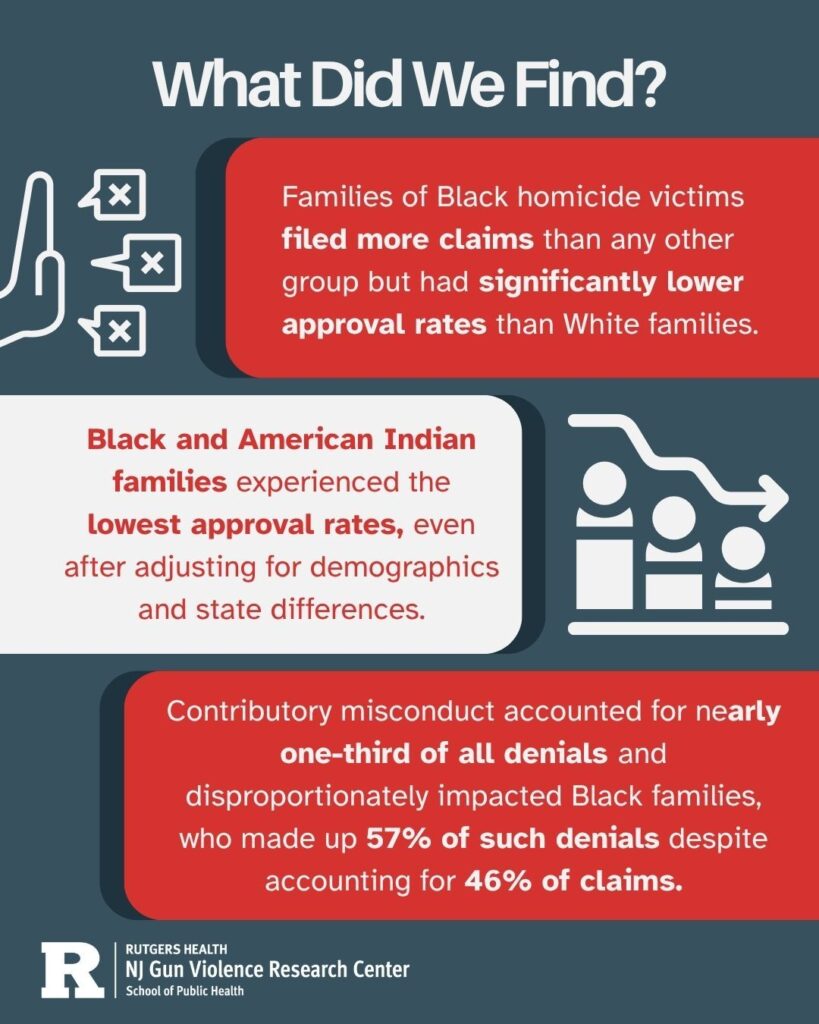

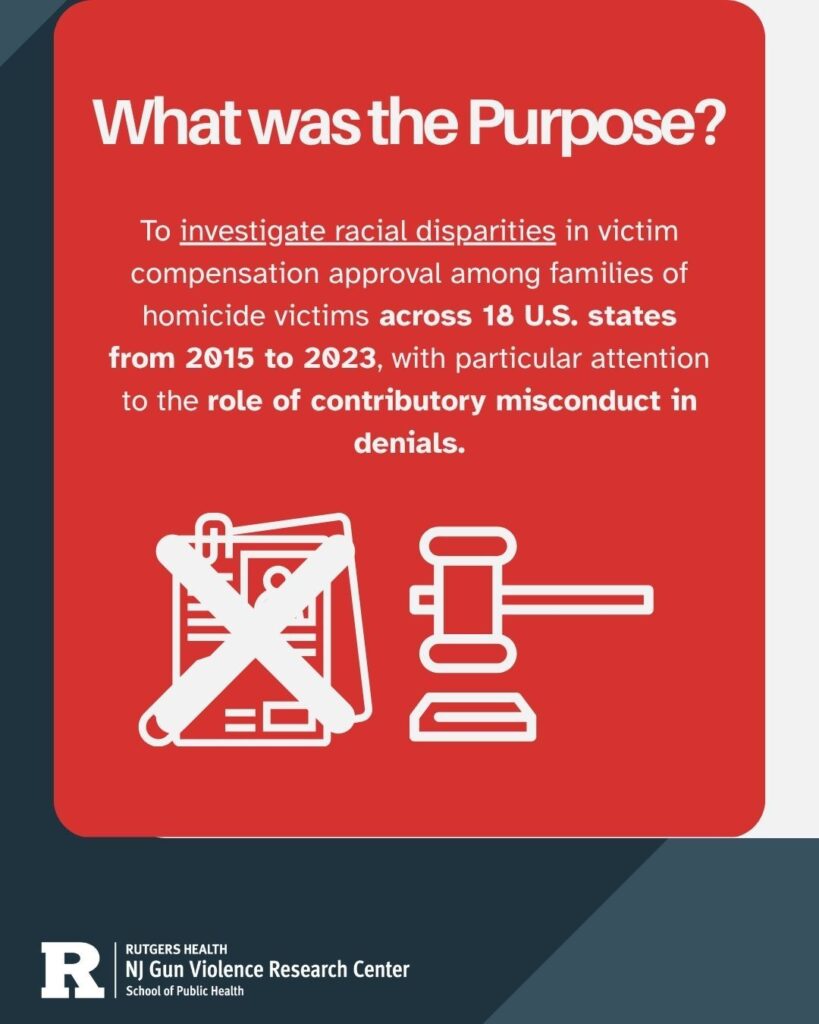

Working with Jeremy Levine, Tyshawn Sharpe, Kelsey Burke, and Brielle Savage, Semenza analyzed nearly 60,000 homicide victim compensation claims filed across 18 states between 2015 and 2023. Together, they found that families of Black homicide victims filed more claims than any other group but were significantly less likely to have them approved compared with White families. Even after controlling for gender, state, and application year, the disparity remained. The most pronounced gap appeared in denials tied to “contributory misconduct”—a broad, discretionary determination often made by law enforcement about whether a victim’s behavior may have contributed to their death. Nearly one-third of all denials fell into this category, and families of Black victims made up 57 percent of them despite accounting for 46 percent of all claims.
The team’s findings underscore how discretion, complexity, and bias built into the process can replicate the very injustices these programs were meant to correct. Their research supports renewed calls to reform the federal Victims of Crime Act (VOCA) Compensation Guidelines, including removing contributory misconduct as a denial category and expanding outreach to underserved communities. By showing how bureaucratic judgment can shape who receives justice after tragedy, Semenza and his collaborators challenge policymakers to confront inequities hidden within the nation’s systems of care.

Related to this Story:
Advancing Justice: The Master of Arts in Criminal Justice Program
The Master of Arts in Criminal Justice at Rutgers University–Camden equips students with an advanced understanding of criminal justice and public policy principles. The 30-credit program includes core courses in policy analysis, research methods, and data analysis, complemented by electives that allow for specialization. Designed to accommodate both working professionals and traditional students, the program offers classes primarily on weekday evenings. Graduates are prepared for leadership roles in justice-related fields or for further doctoral studies.
Spotlights & Stories

Want more stories like this? Spotlights and Stories highlights alumni, faculty, staff, and student experiences through stories, video, and voice. Learn more
Explore Graduate School Programs

Rutgers Graduate School-Camden offers 20+ graduate certificates, master’s, and doctoral programs across various disciplines, including biology, data science, creative writing, and psychology. We take pride in our academic diversity. Learn more
Former Students, Get Involved

Stay connected with Rutgers-Camden! Engage with former students, attend events, and support current students. Your involvement strengthens our community and helps shape future success. Learn more