

All the Northern Lights: A Reflection from Finland
Wonder does not always announce itself. Sometimes it arrives quietly, overhead, while life continues at ground level. In her third reflection from Finland, Ana Laguna turns her attention to a spectacle so iconic it risks becoming ordinary: the Northern Lights. What happens, she asks, when awe becomes expected, scheduled, even marketed. And what do we miss when we try too hard to capture it.
As a Fulbright scholar living in Oulu and Graduate Program Director for the Spanish for Health Professions Certificate, Laguna has been writing through attention and restraint. Her first reflection, Margarit, found meaning in art and intimacy. Her second, Everyday Light, lingered on the small rituals that shape daily life. This third piece widens the sky, exploring patience, timing, and the uneasy impulse to control wonder itself, as part of the Voices of Rutgers–Camden series.
Here is her third reflection.
3: All the Northern Lights by Ana Laguna
People in Finland are used to living with the Northern Lights, the auroras, as they call them here. They seem aware of their luck, a kind of fortune that travelers from all over the world try to share, coming here winter after winter, in the months when darkness begins at 2 p.m. and the Christmas cheer tempts us to meet the cold halfway.
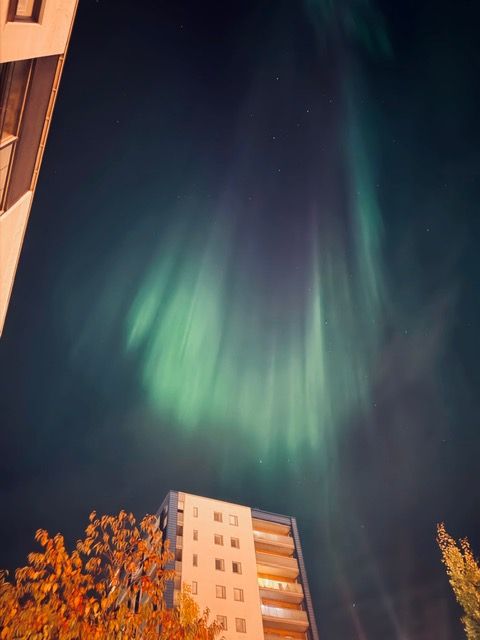
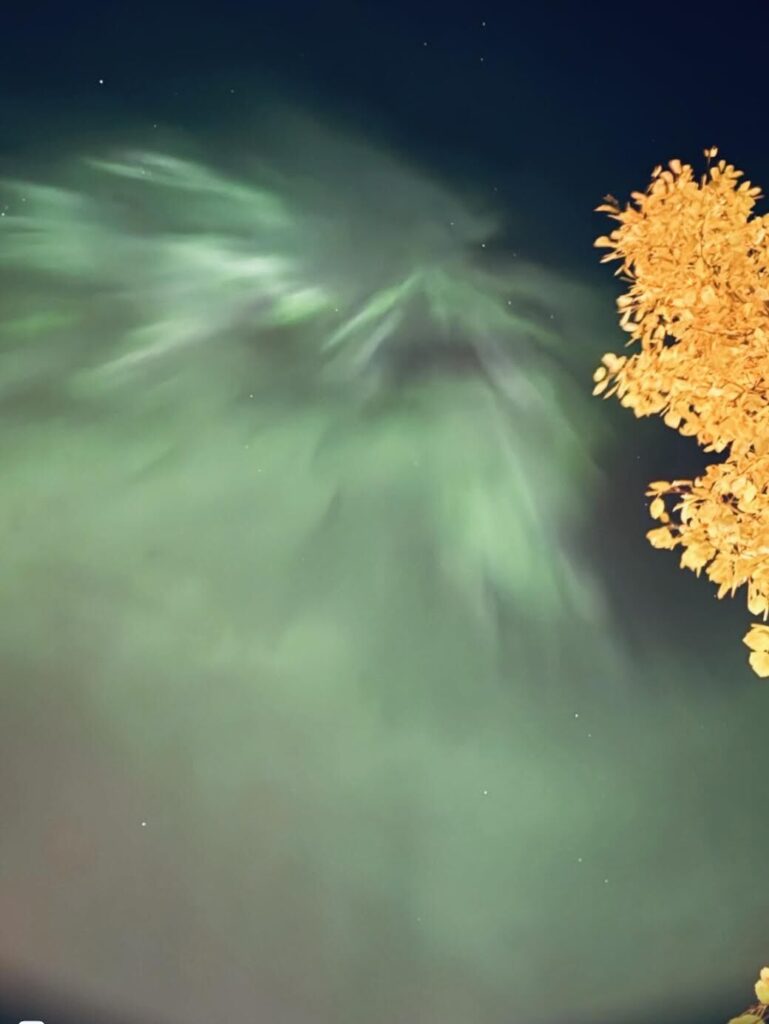
Northern Finland is the Arctic home of Christmas, or so claims Rovaniemi, the fairytale town that has proclaimed itself the official residence of Santa Claus. The Christmas village brims with touristy goods and landmarks, marking the beginning of the Arctic Circle and hosting the so-called “North Pole Post Office” (both must-stops, if you ask me). But these days, a new attraction has begun to stretch its reach all the way to the sky. Winter packages to Lapland now include aurora-hunting experiences, where visitors are loaded into vans, driven across dark roads in search of open skies, and promised a memorable picture. The charming drivers, guided by mysterious apps and spectral graphs, converge on promising locations to deliver that wish, and hopeful visitors, bundled in twenty-five layers of clothing, step eagerly into the snow to stare upward, waiting for green light to pierce the black.
Despite promising “sightings,” these packages are cancelled without regret when conditions are not favorable, a practice no doubt shaped by years of disappointment and long drives through fog, snowstorms, and anticlimax.
I took one of those trips once. And yes, we did see an aurora. But the experience felt oddly hollow, curated even. It was not only because I had already seen the lights from Oulu a few times, flickering in the distance, but because something in the moment felt odd, out of sync, as if wonder itself had been slightly forced or quietly co-opted. I was not sure whether we had conquered nature’s secrets or she was just humoring us, throwing a few ribbons of light across the dark so we would leave feeling chosen.
I remember how differently I felt that unexpected night when they came closest, wrapping the city in green and purple, dancing above rooftops until they burst over my apartment building. I could not believe my half-frozen, overwhelmed eyes as people passed me by, walking their dogs, chatting, heading to the supermarket, apparently impervious to the spectacle overhead.
Now, knowing what I know about local sensibility, I wonder if what I took for indifference was instead a kind of quiet reverence, or maybe discernment. Perhaps, like me in Rovaniemi, they had once seen a display even more astonishing, one that made the lights above look like a rehearsal. Or maybe it simply was not the right night to be taken by nature’s wonder. After all, all ecstasies require good timing.
Related to this story:
The most moving experiences strike each of us differently. There is an alignment between outer wonder and inner readiness, a moment in which we give space to the world or ourselves not to perform, when we understand that nature has its own rhythm and we stop trying to trap it in a photo or squeeze it between dinner reservations. There is something troubling about the impulse to domesticate awe with tours and guarantees. It feels like a small act of violence, not only against nature but against time itself.
We fill our homes and cities with Christmas lights to warm the long nights and celebrate the season. We know when to put them up, and (supposedly) when to take them down. But auroras do not follow any calendar’s dictate. Like the greatest epiphanies in life, they can be hoped for but not rushed, commercialized but not bought.
It is perhaps in that quiet independence, even defiance, where lies a powerful invitation not only to enjoy the experience but its tempo. Maybe that is part of their gift, to teach us patience, dignity, and hope in moments of stubborn uncertainty. After all, it is only when we stop chasing the light that we learn how to stand still in the dark.
Bridge the Gap: Spanish for Health Professions Certificate for Equitable Care
The fully online Graduate Certificate in Spanish for Health Professions is designed for healthcare providers, public health professionals, and medical students seeking to improve communication and cultural fluency with Spanish-speaking patients. With over 37 million native Spanish speakers in the U.S., the program meets a growing demand for inclusive, culturally responsive care. This 12-credit certificate offers flexible, asynchronous coursework grounded in real-world health interactions, and includes the option to pursue Medical Community Interpreter certification. Recognized with awards from AACN, the Fulbright Foundation, and Rutgers University, the program equips professionals to deliver more equitable care, enhance patient trust, and expand their impact across clinical and community health settings.
Spotlights & Stories
Want more stories like this? Spotlights and Stories highlights alumni, faculty, staff, and student experiences through stories, video, and voice. Learn more
Explore Graduate School Programs
Rutgers Graduate School-Camden offers 20+ graduate certificates, master’s, and doctoral programs across various disciplines, including biology, data science, creative writing, and psychology. We take pride in our academic diversity. Learn more
Former Students, Get Involved
Stay connected with Rutgers-Camden! Engage with former students, attend events, and support current students. Your involvement strengthens our community and helps shape future success. Learn more